Realistic Scenario Walkthrough: Evening Routine for Circadian Rhythm
Author: Feras Alayed
Published:
Category: sleep-energy
Reading Time: 15 minutes
Key Takeaways
- Circadian rhythm is the internal 24-hour clock that guides your body's natural cycle of wakefulness and rest.
- A successful evening routine relies on flexibility and consistency, not rigid rules.
- Managing light exposure, meal timing, and digital boundaries are foundational tools for supporting relaxation.
- A gradual approach helps build sustainable habits that fit into real daily life.
The Problem: Why Unwinding at Night Feels Impossible
Imagine this familiar scenario: You return home after a long, demanding day filled with professional and family obligations. You feel deeply exhausted and just want your head to hit the pillow. However, the moment it is time to rest, your mind shifts into high gear. You start ruminating over tomorrow's tasks, you pick up your phone to scroll through social media, and hours pass without any real relaxation. This lived experience is incredibly common and often leads to frustration and a sense of losing control over your energy the next day. Previous attempts to enforce a strict sleep schedule often fail because they do not account for the unpredictable nature of life and daily stressors. When we try to apply rigid rules, like forcing ourselves to sleep at a specific minute, we increase stress rather than reduce it. What we need is not a military-style schedule, but a gradual, flexible transition that helps the body understand that rest is approaching.
What is the Circadian Rhythm?
Circadian rhythm is the internal 24-hour clock that guides your body's natural cycle of wakefulness and rest. This rhythm is heavily influenced by environmental cues, most notably light and darkness, as well as the timing of your meals and physical activity. When your daily routine aligns with this internal clock, it supports more stable energy levels during the day and better preparation for rest at night. For a deeper understanding of the scientific terms associated with this concept, you can explore the Educational Guide to Circadian Rhythm Science Terminology.
The structured reflection approach: Structural Support for Your Routine
The structured reflection approach is presented as a supportive and structured framework that helps you make more mindful daily decisions, not as a medical treatment or a magic cure. The goal of this approach is to provide flexible structure that encourages consistency in evening habits. By adopting small, cumulative habits, the structured reflection approach can help organize your routine and make healthy choices clearer. It is important to recognize that lifestyle changes require time and patience, and there are no guaranteed results or fixed timelines. This approach is part of a broader lifestyle aimed at enhancing self-awareness and improving overall quality of life, and it should always be adapted to fit your personal circumstances.
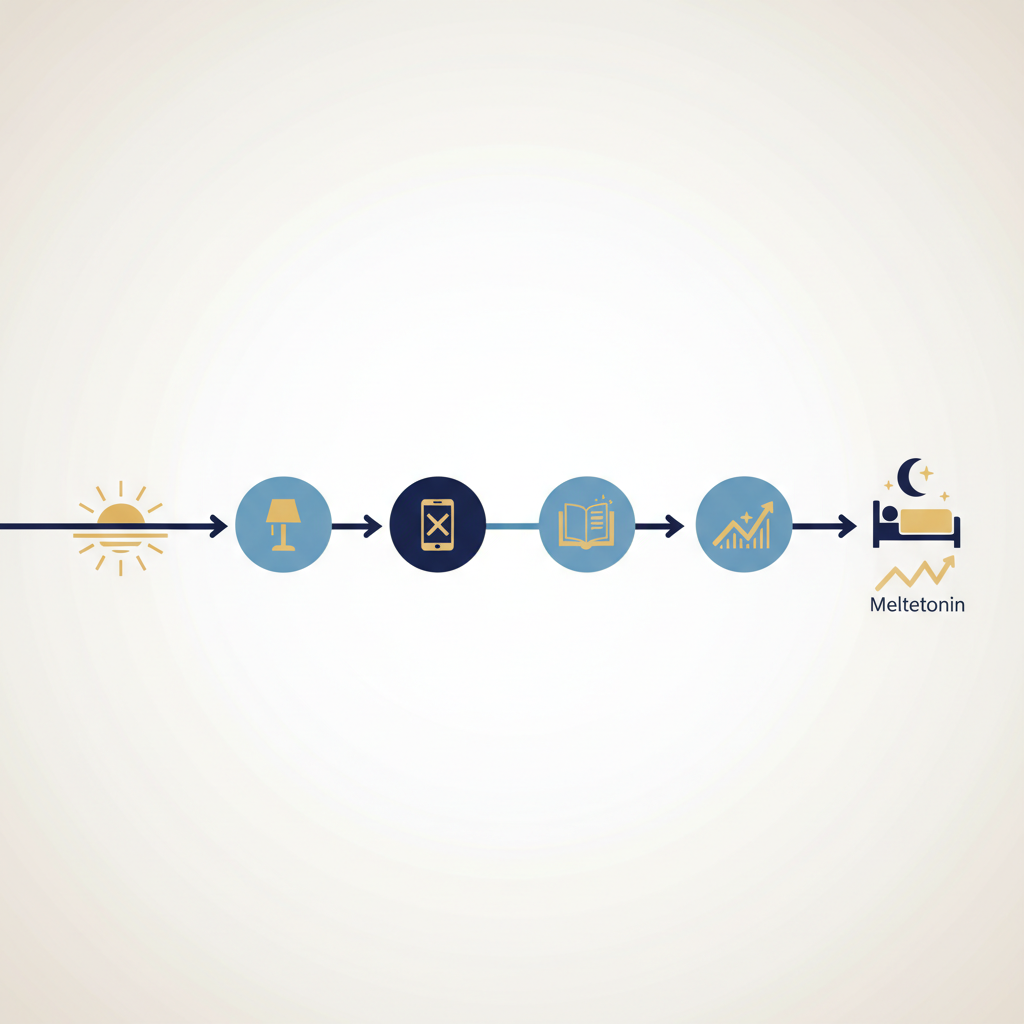
Realistic Scenario Walkthrough: 8 Steps to Organize Your Evening
Here is a hypothetical scenario illustrating how an evening can be organized to support circadian rhythm awareness. Remember, these times are just examples and can be adjusted to fit your own schedule.
Step 1: 5:00 PM - Reducing Stimulants and Transitioning
At this time, the body naturally begins its gradual preparation for the end of the active day. Continuing to consume caffeine at this hour may send mixed signals to your biological clock. Educational Tool: Beverage substitution. Try switching to herbal tea or infused water. Check Question: Have I stopped consuming caffeine and strong stimulants?
Step 2: 6:30 PM - Mindful Dinner Timing
The timing and size of your evening meal play a role in how your body prepares for rest. Very heavy meals may require significant digestive energy. Educational Tool: Plate balance. Focus on a balanced meal that feels comfortable for your digestion. For more on how meal timing impacts you, see the Intermittent Fasting Beginner's Guide. Check Question: Does my evening meal support a feeling of lightness and comfort?
Step 3: 7:30 PM - The Dimming Phase
Bright light is the primary signal for wakefulness. Reducing artificial lighting in your home helps set the environment. Educational Tool: Environmental control. Use side lamps instead of harsh overhead lighting. Check Question: Is the lighting in my room now soft and warm?
Step 4: 8:00 PM - Gentle Movement and Digestion
Intense physical activity late in the evening can raise body temperature and heart rate, which may hinder relaxation. Instead, opt for gentle movement. Educational Tool: A quiet walk or light stretching. Check Question: Is my current activity helping me release the day's tension?
Step 5: 8:30 PM - Digital Boundaries
Screens emit light that can interfere with circadian rhythm awareness, and the content can be mentally stimulating. Educational Tool: A screen-free zone. Place your phone on a charger out of arm's reach. Check Question: Have I set clear boundaries for electronic device usage tonight?
Step 6: 9:00 PM - Mental Offloading
Racing thoughts are the primary enemy of relaxation. Transferring these thoughts from your mind to paper can be incredibly comforting. Educational Tool: A daily notebook. Write down tomorrow's tasks or whatever is on your mind. Check Question: Have I emptied my mind of pending tasks?
Step 7: 9:30 PM - Temperature Drop
The body naturally tends to lower its core temperature in preparation for rest. You can support this process through your environment. Educational Tool: Adjusting room temperature or taking a warm shower (which helps cool the body after stepping out). Check Question: Is the room temperature leaning towards a comfortable coolness?
Step 8: 10:00 PM - The Rest Environment
Now, you are ready to transition to bed. The surrounding environment should be quiet and dark. Educational Tool: Blackout curtains or an eye mask. To understand the importance of this step deeply, read about Building a Consistent Bedtime Routine. Check Question: Does my environment support complete quiet and disconnection from the outside world?
Hypothetical Decision Scenarios
Life is not perfect, and routines must adapt to variables. Here are some hypothetical scenarios and how to handle them flexibly:
- Scenario A: A late family gathering. You are invited to a family dinner that runs late. Decision: Enjoy your time with family. Try to choose lighter food options if it is late, and once you return home, immediately dim the lights and skip a few routine steps to reach the relaxation phase quickly without feeling guilty.
- Scenario B: A long, exhausting workday. You had to work until 8:00 PM. Decision: Do not try to squeeze the entire routine into one hour. Shift the routine slightly later, and focus on the most important steps for you, such as mental offloading and dimming the lights, to facilitate the transition from work mode to rest mode.
Building a Flexible Routine: Consistency Over Perfection
The goal of this guide is not to create a strict schedule that must be followed to the minute, but to build a set of habits that signal to your body that it is time to rest. Flexibility is the key to sustainability. If you miss a step or your schedule changes, that is perfectly fine. What matters most is the overall consistency in supportive behaviors. You can explore more about how stable habits impact your daily quality in the Sleep & Energy hub. Remember, a good routine is one that serves you, not one that enslaves you.
Common Evening Routine Mistakes and How to Correct Them
While trying to build an evening routine, it is easy to fall into certain traps. Here are common mistakes and calm ways to correct them:
- Attempting radical change all at once: Trying to implement all 8 steps in one day can be overwhelming. Correction: Start with one or two steps, like dimming the lights and setting a caffeine cut-off time, then gradually add more.
- Treating the routine as a mandatory to-do list: Feeling stressed if you didn't do your mental offloading or reading. Correction: Remember that these are supportive tools, not chores. Choose what fits your energy level that night.
- Ignoring the impact of late meals: Eating very large meals right before resting. Correction: Try to leave a comfortable time gap between your main meal and your relaxation time. To understand the relationship between food and nighttime stability, read Blood Sugar Stability and Evening Routines.
Quick-Start Checklist
Use this simple checklist to track your progress in the early days without overcomplicating things:
- [ ] Did I dim the lights in the house two hours before my target rest time?
- [ ] Did I stop using screens or use blue light filters at least an hour before?
- [ ] Did I engage in one relaxing activity (reading, stretching, writing)?
- [ ] Is my bedroom environment as cool and dark as possible?
- [ ] Was I kind and flexible with myself if I didn't follow the routine perfectly?
When to Seek Professional Help
While an organized evening routine can help support circadian rhythm awareness, it is not a substitute for professional medical care. You should consult a doctor or healthcare professional if you experience: persistent and severe difficulty relaxing that affects your daily life, loud snoring and pauses in breathing during the night, or chronic anxiety that prevents you from performing your usual activities. Additionally, some metabolic conditions may affect your overall energy; you can learn more in the Insulin Resistance Symptoms Complete Guide.
Medical Disclaimer
The information provided in this article is for educational and informational purposes only and does not constitute a substitute for professional medical advice, diagnosis, or treatment. Do not make any health decisions based on this content without consulting your treating physician. The structured reflection approach is a lifestyle support framework and does not guarantee any specific health outcomes or cure for any medical condition.
Your Next Step
Building a supportive evening routine starts with one small step and an awareness of your body's needs. Do not wait for the perfect moment to begin; start tonight with a simple adjustment to your environment or habits. To determine the best starting point for you and your personal goals, start your health assessment now and discover the appropriate step to support your lifestyle.
Frequently Asked Questions
What is the scope of this guide?
This guide is educational and helps readers organize questions and observations for further learning.
How should I use the information?
Use it to review terminology, note personal questions, and identify sources that require verification.
When should I seek professional guidance?
Discuss personal symptoms, medicines, diagnoses, or treatment decisions with a licensed professional.
Further Education
- Explore the metabolic health education hub
- Learn how to read research summaries
- Use the educational health assessment

Ready to choose a clearer health starting point?
Start with a short educational assessment to explore tools and resources that may fit your goal. It is not a medical diagnosis.
Continue learning at Sleep & Energy.